
Hypothesis testing is a core principle in statistics and data science. It helps analysts make decisions using data rather than assumptions. In simple terms, hypothesis testing allows you to check whether a claim about data is likely to be true.
Many real world decisions rely on statistical evidence. Businesses test marketing strategies, scientists evaluate experiments, and data analysts examine patterns in data. Hypothesis testing provides a structured way to analyze results and determine if a change or relationship is statistically meaningful.
For beginners entering the world of analytics, understanding this concept builds a strong statistical foundation. If you want to develop practical skills in statistics and data analysis, consider enrolling in the Data Science Course in Trivandrum at FITA Academy to gain hands-on knowledge and industry relevant experience.
Understanding the Basic Idea
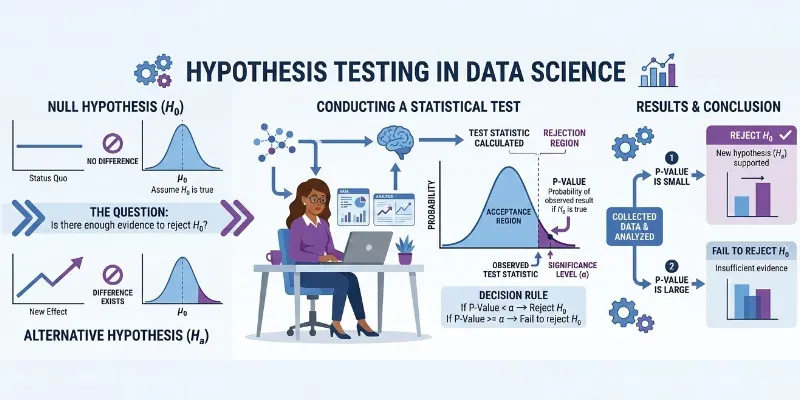
At its core, hypothesis testing compares two ideas about a dataset. The first idea is called the null hypothesis. It represents the assumption that nothing unusual is happening or that there is no real effect.
The second idea is called the alternative hypothesis. It suggests that there is a meaningful difference, relationship, or change present in the data.
For example, imagine a company launching a new product feature. The null hypothesis might state that the feature does not affect user engagement. The alternative hypothesis would claim that the feature increases engagement. Statistical testing helps determine which idea the data supports.
Key Steps in Hypothesis Testing
Hypothesis testing follows a clear process that helps analysts draw reliable conclusions.
The first step is defining the null hypothesis and the alternative hypothesis. These statements clearly explain what you are testing.
The next step is choosing a significance level. This value, often set at 0.05, represents the threshold for deciding whether the result is statistically significant.
After this, analysts collect data and calculate a test statistic. This value measures how far the observed results are from what the null hypothesis predicts.
Finally, the p value is calculated. The p value reflects the likelihood of obtaining the results assuming that the null hypothesis is accurate. If the p value is less than the selected significance level, the null hypothesis is dismissed.
If you want to learn these statistical concepts through practical examples and real datasets, you can consider taking the Data Science Course in Kochi to build deeper analytical skills and confidence.
Why Hypothesis Testing Matters in Data Science
Hypothesis testing plays an important role in data driven decision making. It helps professionals validate assumptions before making important choices.
In business analytics, A/B testing is frequently utilized to evaluate two variations of a product or service. In healthcare research, hypothesis testing helps determine whether a treatment is effective. In marketing analytics, it helps evaluate campaign performance.
Without statistical testing, many conclusions would rely on guesswork. Hypothesis testing reduces uncertainty and allows analysts to support their findings with measurable evidence.
This ability to test ideas using data is one of the core skills that separates a skilled data professional from someone who only performs basic analysis.
Common Mistakes Beginners Should Avoid
Beginners often misunderstand how hypothesis testing works. One common mistake is assuming that rejecting the null hypothesis proves something with complete certainty.
Statistical testing essentially shows that the observed outcome is improbable when assuming the null hypothesis is true. It does not guarantee that the alternative hypothesis is absolutely true.
Another mistake is ignoring sample size. Small datasets may produce misleading results because they do not represent the larger population accurately.
Misinterpreting p values is also a frequent issue. A small p value does not measure the importance of a result. It only shows how unlikely the result is under the null hypothesis.
Understanding these limitations helps analysts use hypothesis testing responsibly and interpret results correctly.
Hypothesis testing is an effective statistical method that allows analysts to assess assertions based on data. By comparing assumptions and calculating probabilities, data scientists can determine whether patterns in data are meaningful or simply due to chance.
Learning this concept early helps build strong analytical thinking and improves the quality of data driven decisions. If you want to develop practical expertise in statistics, machine learning, and real world analytics, join the Data Science Course in Pune to strengthen your data science career path.
Also check: Why Linear Algebra Matters in Data Science