
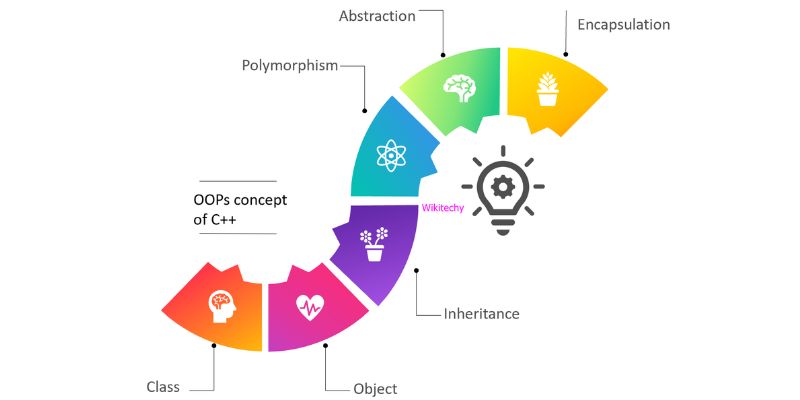
C++ is one of the best implementations of Object-Oriented Programming (OOP), one of the most potent paradigms in contemporary software development. Understanding OOP in C++ enables you to design code that is structured, reusable, and simple to maintain, whether you’re creating desktop programs, gaming engines, or system-level software. OOP encourages you to arrange programs around objects real-world entities with qualities and behaviors, rather than just functions. C++ gives you full control over system resources and programming structure, unlike limited high-level languages. FITA Academy provides comprehensive C++ training.
This method simplifies the design and management of complicated systems by reflecting how humans naturally view the environment. Maintaining scalable and clean code becomes crucial as software projects get bigger, and this is where OOP principles come into play. We’ll dissect the fundamental ideas of C++ OOP in this blog, look at real-world examples, and offer advice to help you use these ideas successfully in everyday situations.
Understanding Object-Oriented Programming in C++
The concept of grouping data and functions into a single unit known as a class is the foundation of object-oriented programming in C++. To create objects, which are instances of a class, a class serves as a blueprint. Every object has methods (functions) and attributes (data) that specify how it behaves. Take the class Car, for instance. It can have methods like accelerate() and brake() as well as characteristics like color and speed.
Developers can more easily model real-world systems with this framework. C++ is a flexible hybrid language that enables both procedural and object-oriented programming. Developers can divide complex issues into smaller, more manageable components by utilizing OOP. This modular approach makes debugging and testing easier while also improving readability. As you dive deeper into C++, mastering OOP becomes essential for writing efficient and professional-grade software.
Encapsulation: Protecting Your Data
Encapsulation is the concept of wrapping data and the methods that operate on that data into a single unit, typically a class. In C++, this is achieved with access specifiers like private, public, and protected. Declaring variables private ensures data integrity by preventing direct access from outside the class. Rather, you use public methods called getters and setters to grant restricted access. For example, you wouldn’t let direct editing of the balance variable if you had a class called BankAccount. C C++ Training in Chennai offers practical, industry-oriented instruction that helps learners master programming fundamentals, memory management, data structures, and system-level development. To handle it securely, you would instead write methods like deposit() and withdraw().
This method improves security and stops unintentional alterations. Because modifications to the underlying implementation do not impact the external code, encapsulation also improves the maintainability of your project. It’s a basic idea that encourages clear design and lowers the possibility of errors in big applications.
Abstraction: Simplifying Complexity
The goal of abstraction is to display only an object’s most important characteristics while concealing intricate implementation details. Classes and abstract classes with virtual functions are commonly used to implement abstraction in C++. The intention is to enable consumers to engage with items without having to comprehend their internal workings. For instance, you don’t have to think about how the engine works when you use a Car object; you just use drive().
This lessens cognitive burden and streamlines development. By separating interface from implementation, abstraction also helps developers create scalable and adaptable systems. Pure virtual functions, which require derived classes to provide certain implementations, are one way to accomplish abstraction in C++. This guarantees uniformity among various software components. Abstraction makes code structures clearer and easier to understand by concentrating on what an object does rather than how it does it.
Inheritance: Reusing and Extending Code
One class can inherit the characteristics and actions of another class. This lessens repetition and encourages code reuse. A derived class in C++ uses a straightforward syntax to inherit from a base class. For instance, you may have derived classes like Dog and Cat that inherit the eat() method from the basic class Animal. Training Institute in Chennai focuses on hands-on, industry-oriented learning to help learners master programming fundamentals, object-oriented concepts, memory management, and system-level development.
Rewriting common code is no longer necessary as a result. Additionally, inheritance facilitates hierarchical interactions, which facilitates the modeling of real-world systems. Furthermore, single, multiple, and hierarchical inheritance are all permitted in C++. Inheritance is strong, but it must be handled wisely to prevent too complicated structures. When used properly, it improves the scalability and maintainability of programming.
Polymorphism: One Interface, Many Forms
Objects can be handled as instances of their base class thanks to polymorphism, which also permits distinct actions depending on the kind of object. Function overloading and virtual functions are two ways that C++ achieves polymorphism. While virtual functions provide runtime polymorphism, function overloading permits several functions with the same name but distinct parameters. For instance, derived classes like Circle and Rectangle may implement the virtual function draw() in a different way from the base class Shape.
The appropriate version is run depending on the object type when you call draw() on a base class pointer. Your code becomes more dynamic and adaptive as a result of this flexibility. In huge systems where components must work together flawlessly, polymorphism is very helpful. It increases productivity and decreases duplication by enabling developers to design generic code that works with various data types.
Advantages of Using OOP in C++
OOP in C++ is a recommended method for software development because of its many advantages. Code reusability, which cuts down on development time and effort, is one of the main benefits. While abstraction makes complicated systems simpler, encapsulation guarantees data security. Polymorphism adds flexibility, whereas inheritance enables you to expand upon existing code. When combined, these ideas provide a solid foundation for creating scalable applications. This is the introduction of c. Additionally, OOP enhances code organization, facilitating team collaboration on big projects.
Debugging becomes easier because issues may be contained to specific classes. Additionally, because OOP closely resembles real-world models, it makes system design intuitive for developers. As the business continues to demand efficient and maintainable software, mastering OOP in C++ gives you a significant advantage in your programming career.
Common Mistakes Beginners Make
Beginners frequently make a few typical blunders that can impede their development when learning C++ OOP. Overuse of inheritance is a common problem that can result in intricate and difficult-to-maintain code structures. Inadequate use of access specifiers leads to inadequate encapsulation and possible security threats. Additionally, a lot of students have trouble grasping pointers and memory management, which are essential concepts in C++. Resource leaks may result from undervaluing constructors and destructors.
Furthermore, novices may abuse polymorphism by neglecting to specify functions as virtual. By concentrating on the basics and practicing often, these errors can be prevented. Concepts are reinforced by writing simple programs and progressively adding complexity. Your comprehension will also be enhanced by frequently troubleshooting your code and learning from real-world examples. Early avoidance of these issues lays a solid foundation for C++ OOP mastery.
Practical Tips to Improve Your OOP Skills
It takes time, effort, and smart study to get better at OOP in C++. To apply OOP concepts, start by creating little projects like a basic game or a library management system. Divide functionality into clearly defined classes and concentrate on producing clear, modular code. To make your classes and functions easier to read, give them meaningful names. To learn how seasoned developers organize their code, practice using design patterns. Another crucial ability is debugging, which involves closely examining faults to determine what went wrong.
Examining the code of other developers might also yield insightful information. Use version control solutions to efficiently manage your projects as well. Continue experimenting with various OOP principles and consider alternate approaches to their implementation. You’ll get a greater comprehension of how to use C++ to create scalable and effective systems over time. The secret to mastering OOP is consistency and practical experience.
Final Report
The foundation of contemporary software development is made up of the fundamental C++ OOP concepts of encapsulation, abstraction, inheritance, and polymorphism. These ideas enable you to write code that is not just effective but also simple to scale and maintain.
Even while the learning curve might initially seem difficult, these ideas will become second nature with regular practice and practical implementation. Learning C++’s OOP capabilities can lead to a plethora of programming options. C++ is still a robust language. Learning OOP will greatly improve your coding abilities and employment prospects, regardless of your level of experience.